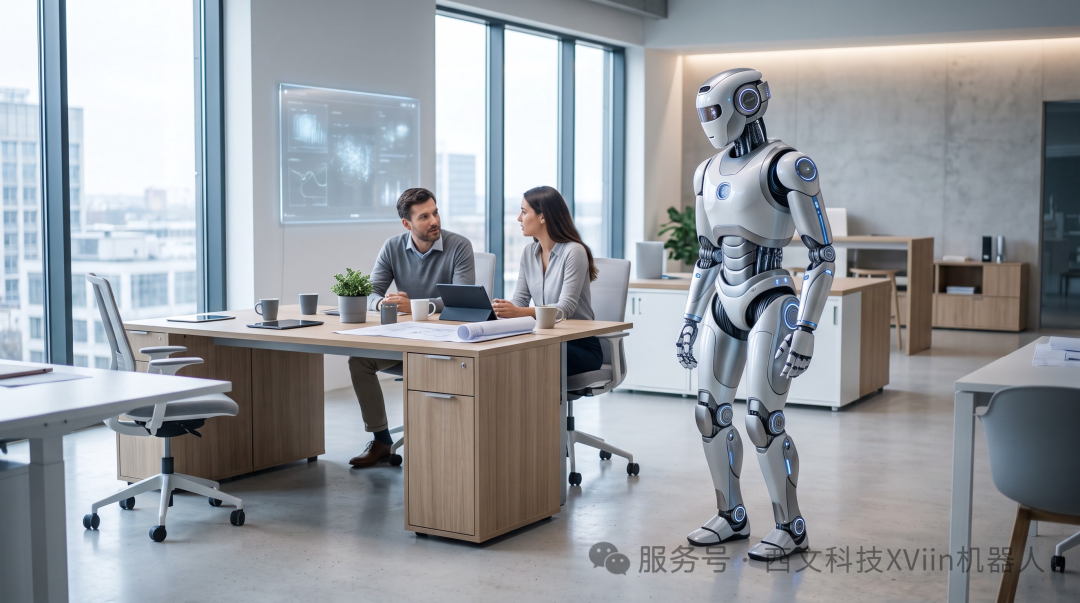
Over the past few decades, advances in robotics have primarily been reflected in their increasingly sophisticated locomotion capabilities.They can precisely perform tasks such as material handling, welding, and assembly. But when robots actually enter homes, commercial spaces and complex industrial environments, a more important question arises:Will robots really "understand" the world?From traditional automation to physical intelligence, robots need to solve at least five problems to become really smart.Can 1. robots understand the world?
When human beings see a table, they naturally know where to put things, which cup to hold, and which items may break.Robots, however, need to understand this information step by step through cameras, sensors and AI models.Therefore, the visual ability of future robots can not only stop at "recognizing objects", but also need to be further understood:What is this? Where is it? What does it have to do with the surroundings? What can I do with it?This means that robots are moving from traditional machine vision to multi-modal environmental perception.Xiwen Technology'sXVIIN Xiwen RobotIt is exploring the technical direction of multi-modal perception, motion control and artificial intelligence, so that robots can better perceive and understand the real environment.Can 2. robots predict the next step?
Seeing the world is just the beginning.Assuming that there is a cup at the table, the robot not only needs to know that "this is a cup", but also needs to know that if it continues to push, it may fall; if it grasps too hard, it may break.That's what robots need.World understanding and predictive power。The "world model", which has attracted attention in recent years, is trying to get AI to answer an important question:If I do this, what happens next?This predictive ability is especially important for robots.Because the AI answer is wrong, it may just be that the answer is inaccurate; and the robot's wrong action may cause collision, damage and even safety problems.Can 3. robots turn "understanding" into "action"?
Humans hear "Bring the cup on the table" and can do it almost immediately.However, the robot needs to solve the problems of visual recognition, task understanding, path planning and motion control at the same time.This is also an important reason why VLA(Vision-Language-Action, Vision-Language-Action) has received attention.Future robots may no longer just "follow the program",:See the environment → understand the instructions → make actions → complete the task.This is also an important difference between body intelligence and traditional robots.What XVIIN robot explores is the coordination between AI ability, perception system and motion control, which makes the robot gradually develop from "execution equipment" to "intelligent terminal.Can 4. robots learn from their mistakes?
Humans learn to walk and ride, not by mastering all the action parameters in advance, but by constant experimentation and feedback.Robots need similar capabilities.Execute → Feedback → Adjust → Re-executeWhen the robot can continuously obtain data and experience from the real environment, it can gradually adapt to complex scenes.Therefore, the future robot competition is not only hardware, but also includes algorithms, data and real application scenarios.Can 5. robots have common sense "?
This is the hardest problem.We know that glass is easy to break, that hot water can not be directly touched, but also know that in the crowd should take the initiative to avoid.These seemingly simple common sense, but it is difficult to write all into the robot through the traditional program.True physical intelligence requires robots to be able to judge and adjust when facing unfamiliar environments.This means that robots will eventually need to have:A complete closed loop of perception, understanding, prediction, action and learning.
From "moving" to "thinking"If we put these five questions together, we will find:The true intelligence of robots is not just to make the robot arm more flexible and make the robot go faster.What really matters is that it gets done gradually:I can see, understand, think clearly, do it, and learn continuously.This is also the fundamental reason why physical intelligence is concerned.From artificial intelligence, multimodal perception, to VLAs, world models, and motion control, robots are moving from an "automated device" to an agent that can understand and participate in the real world.Xiwen Technology and itsXVIIN Xiwen RobotThey are also exploring in this direction.In the future, when intelligence really enters the robot, the robot may no longer just perform an action for a person, but be ableUnderstand a task and do it autonomously in real space.This may be the beginning of robots becoming really smart.-- Xiwen Technology/XViiN Robotics