Over the past few years, the pace of artificial intelligence development has been astonishing.From large language models understanding text, to vision models recognizing images, and then to AI being able to control robots to complete tasks, AI is gradually breaking through the boundaries of the digital world.But one key question remains:Do AI really "understand" the world?When people see a cup, they not only know that it is a "cup", but also naturally judge its position, shape, weight and whether it is easy to break.If the cup is placed on the side of the table, we can even predict that it may fall off with a little touch.This kind ofSpace, Objects, Change, Cause and Effect, and Future Statesunderstanding is an important part of human intelligence.Making machines have similar capabilities is the problem the World Model is trying to solve.
What is the 1. World Model?
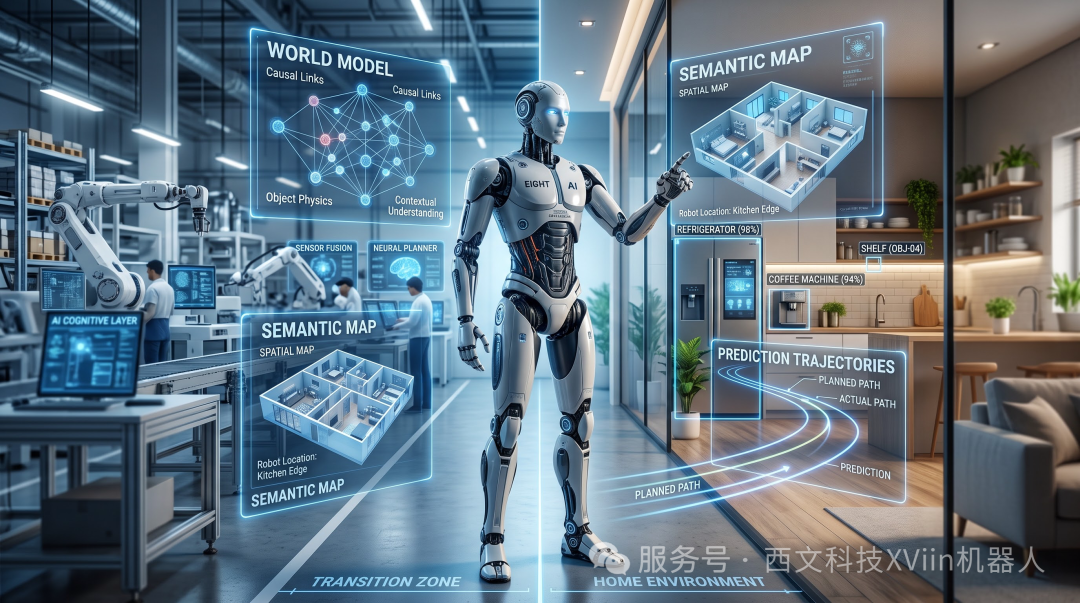
The world model is a set of models built internally by AI about the laws of the real world.It doesn't just tell AI "what's in front of us", it needs to be further understood:What is the relationship between objects?What is changing in the environment?If a certain action is taken, what will be the result?For example, a robot sees an apple on the table.An ordinary vision system might tell a robot:"Here is an apple."
AI with world model capabilities need to be further understood:The apple sits on the table at a certain distance from the robotic arm; the robot needs to avoid other objects on the table; if the robotic arm moves to the position of the apple, it can try to grab it.
From "recognizing an object" to "understanding the relationship between an object and its environment", this is what the world model is concerned.
2. from VLM to VLA:AI are getting "eyes" and "hands"
To understand the world model, you can first understand two important concepts:VLM,Vision-Language Model。It allows AI to process visual and verbal information simultaneously."How many people are there in the picture?"
"What is the object on the table?"
"What happened in this scene?"
And the VLA, I .e.Vision-Language-Action ModelTo further connect vision, language and robot action."Take the cups on the table to the kitchen."
The robot needs to complete:See the cup → understand the instruction → position the cup → plan the action → control the mechanical arm → finish grasping.Therefore, it can be simply understood:VLM: Understanding the WorldVLA: Action Based on UnderstandingThe world model attempts to further address:Predict how the world will change.
The most important ability of the 3. world model: forecasting
One of the biggest differences between the world model and the ordinary AI system is thatPredicting future states。For example, the robot is ready to pick up a cup.Before actually performing the action, it may need to judge:What happens if the arm moves to the left?
What happens if the grab position shifts?
What happens if too much force is applied?
What should I do if an obstacle suddenly appears in front of me?
This ability can be understood as AI to conduct a "future simulation" internally ".Humans often perform similar psychological rehearsals before doing things.For example, when we pick up a cup full of water, we will naturally control the strength and speed.Action changes the world, and the world gives feedback to action.The world model wants to give robots this ability over time.
4. why is the world model so important for physical intelligence?
If big language models exist primarily in the digital world, then physical intelligence needs to really enterPhysical world。The robot is not faced with a piece of text, but a real environment that is constantly changing.It needs to be handled simultaneously:Space, time, objects, physical laws, actions, and feedback.The first step is to identify:"This is a cup."
The second step, it needs to understand:"It's a fragile object."
The third step, it needs to predict:"If the grip is too strong, the cup may break."
The fourth step, it requires action:"Adjust the position of the robot arm to complete the grasp with the appropriate force."
In the fifth step, it also needs feedback and correction according to the results.The whole process can be summarized:Perception → Understanding → Prediction → Decision → Action → FeedbackThe world model is an important technical direction that connects these links.
The 5. world model is like an "internal simulator" for robots"
The world model can be understood as a set of "simulators" inside the robot ".Before the robot acts in the real world, it can predict internally:"What happens if I do this?"The robot needs to move a box to another location.- Where the box is currently located;
- What obstacles are around;
- from which direction the robotic arm should approach;
- How the box will move after grabbing;
- Whether collision is possible during the movement;
- How it should be placed after reaching the target location.
If the real-world environment changes, the robot can recalculate based on the new visual and sensor information.Therefore, a truly mature physical intelligence does not simply execute a fixed program.Understand the environment → predict changes → make plans → perform actions → constantly adjust according to feedback.
How far is the 6. world model from maturity?
At present, the world model is still in the stage of rapid development.Because the real world is far more complex than the words and pictures on the Internet.The real environment has:Three-dimensional space, continuous time, complex physical laws, uncertainty, and a large number of emergencies.Robots in laboratories can perform standardized tasks, but when they enter complex environments such as homes, factories, and shopping malls, problems will increase rapidly.The position of a cup has changed;A person suddenly passes in front of the robot;There are obstacles on the ground;For the first time, a robot encounters an object it has never seen before.This means that future world models need to have stronger:Spatial understanding ability, physical understanding ability, long-term memory ability, causal reasoning ability, future prediction ability and real-time adaptation ability.This is also an important direction for the current artificial intelligence and robotics industry to continue to explore.
7. from "will say" to "will do", AI are entering the next stage
If you look back at the development of artificial intelligence, you can see an increasingly clear path:Large language model → visual language model → visual-language-action model → world model → physical intelligenceAI first learn to process language.Then begin to understand the visual information.Further connect vision, language and action.Ultimately, it needs to understand how the real world works and be able to act consistently in that world.The AI competition is moving from "who has more knowledge" to "who can better understand and change the real world".Artificial intelligence in the future may no longer be just a conversation window in a computer or mobile phone.It may have bodies, sensors and actuators, entering factories, homes, commercial spaces and more.And the world model has the potential to become connectedDigital Intelligence and the Physical Worldimportant bridge.For physical intelligence, this may be the real next stop.
Conclusion
Making the machine see the world is the first step.Making the machine understand the world is the second step.Let the machine predict the world, and take action in the world, it is possible to truly move towards physical intelligence.The world model is helping AI build their own "worldview".And as models, algorithms, and robot ontologies are further integrated with real scenes, AI will move from digital intelligence on the screen to real-world intelligence.Embodied intelligence。In the future, AI will not only answer our questions, but also may really enter our lives.-- Xiwen Technology/XVIIN Robotics