What is it? one word:VLA is a large model that allows robots to "see, understand and move.
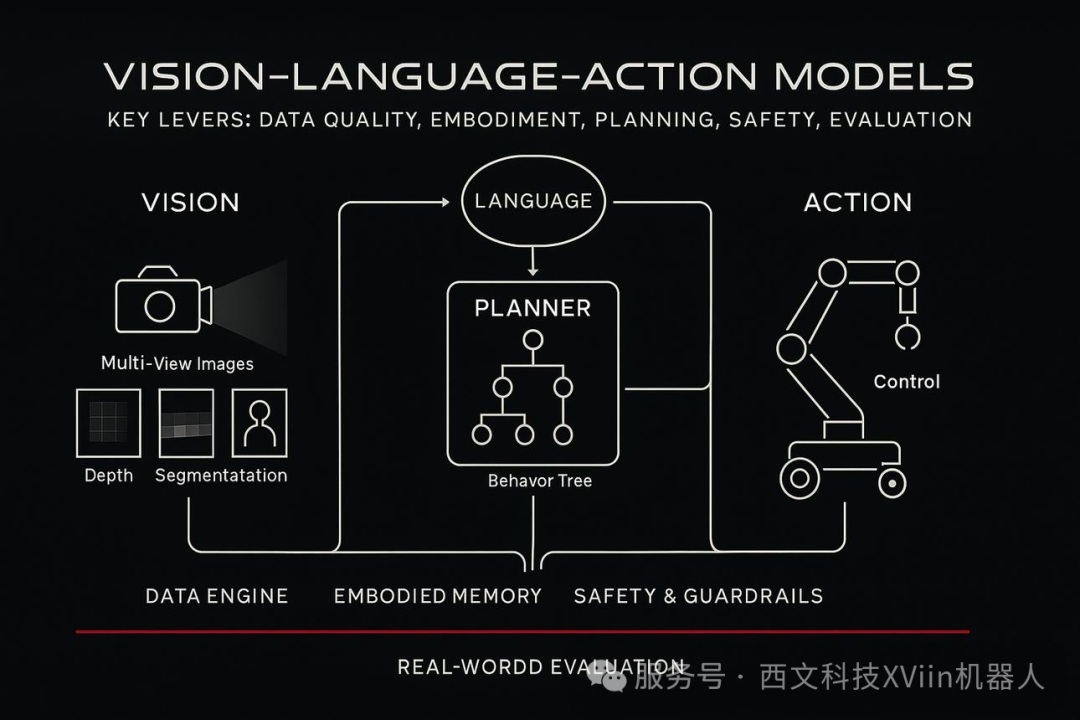
The full name of VLA is Vision-Language-Action Model, which is called "Vision-Language-Action Model" in Chinese ". It puts three abilities into the same AI system: vision is responsible for understanding the world, language is responsible for understanding instructions, and action is responsible for controlling robot execution. For example, if you say "give me the red cup on the table", it not only understands this sentence, but also understands which cup is, where the red is, how to extend the mechanical arm and when to close the jaws.
The familiar LLM, such as chatbots, is to input text and output text.
VLM, a visual language model, is an input picture plus text, output text, and is good at "looking at pictures and talking".
While VLA, the input is image, language and robot state, the output isAction。
So a simple analogy can be made:
LLM: text in, text out;
VLM: Text in, text out;
VLA: Graphic status advance, action.
VLA is equivalent to adding an "action solution dock" to VLM ". It will not only understand the world, but also change the world.
The typical process is: the camera collects images, the human gives language instructions, and the model combines vision, language and the current state of the robot to directly output action sequences, such as moving, grabbing, rotating, and placing. After the robot is executed, the camera sees a new picture, and the model continues to adjust to form a closed loop.
This is very different from traditional robots. Traditional robots are usually broken down into multiple modules of perception, language understanding, task planning, and motion control, and each link is developed separately. What the VLA is after isEnd-to-end: A model, from seeing, understanding, to directly outputting actions.
Because it is seenEmbodied intelligenceThe key direction. In the past, robots were good at repeating actions in a fixed environment, and when they arrived in the open world, they were prone to failure. VLA hopes to use the generalization ability of large models to make robots adapt to new objects, new instructions and new environments like humans.
That's why big factories and capital are betting. Google has RT-1 and RT-2, open source community has OpenVLA,Physical Intelligence launches π 0,Figure makes humanoid robot VLA,NVIDIA releases GR00T N1. Everyone is arguing for the entrance of robots from "special automation equipment" to "general intelligence.
It may reshape the robot industry chain. Upstream is computing power, chips, sensors, midstream is the model, data, simulation platform, downstream is manufacturing, logistics, home services, medical rehabilitation and other scenarios. Whoever has high-quality robot data will be able to build a new moat. Because there is a lot of text and image data on the Internet, but robot action data is extremely scarce.
For investors, VLA is not a single company concept, but a chain: computing power, data, hardware, scenarios, all of which are indispensable. For students and technology enthusiasts, it combines multi-modal large models, robot learning, and control theory, and is the next frontier intersection of AI.
But the difficulty is also obvious
First, data is scarce. Robot action data is far less than Internet text.
Second, real-time. Large models are slow to reason, but robot control requires millisecond response.
Third, security. The wrong action may crash things, or even hurt people.
Fourth, generalization is difficult. The laboratory can run, the real world is complex and changeable.
Fifth, the cost is high. Training and deployment require a lot of computing power and hardware.
So, the VLA is hot, but it's still a long way from truly versatile, reliable, and cheap robots.