News Details

N E W S   D E T A I L

图灵70多年前的预言:读懂具身智能,AI的下一个时代

Turing's prediction more than 70 years ago: reading the next era of physical intelligence, AI

2026-10-21 1 Reading
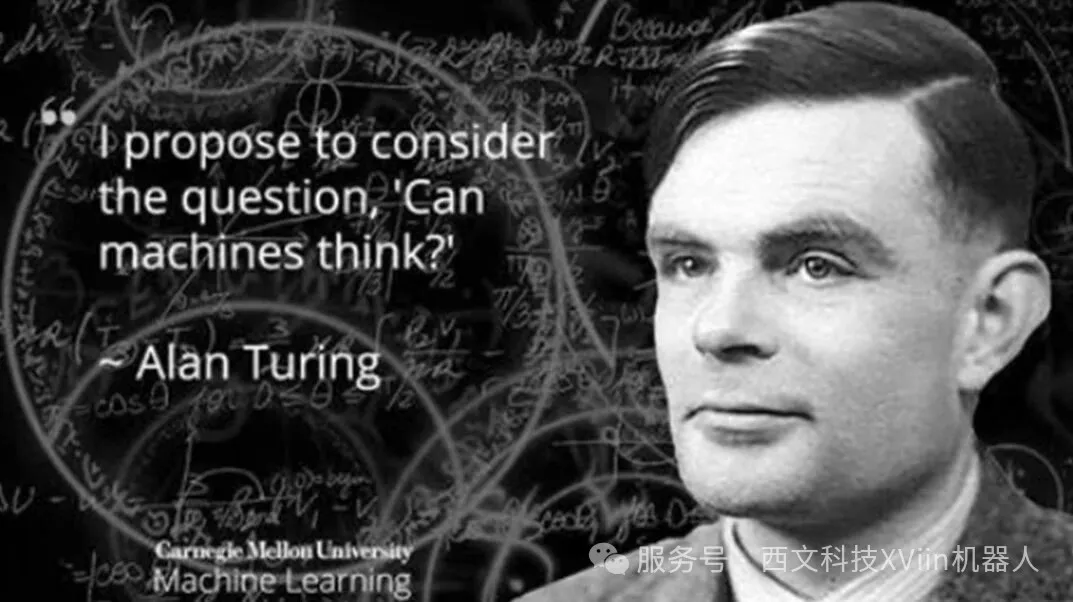
In 1950, Turing discussed the fundamental question of "whether machines can think" in his classic paper "Ccomgouting Machninery and Inteligence". He believed that the ultimate form of artificial intelligence is a robot/simulator (in a virtual environment) that can interact with the environment, plan, make decisions, act and execute independently like a human. The two paths that are expected to be realized are one that focuses on the intelligence required for abstract calculations (such as chess), and the other is to equip machines with the best sensors so that they can communicate with humans and learn like babies. Subsequently, these two

Turing's prediction more than 70 years ago: reading the next era of physical intelligence, AI

The Origin of Body Intelligence

In 1950, Turing discussed the fundamental question of "whether machines can think" in his classic paper "Ccomgouting Machninery and Inteligence". He believed that the ultimate form of artificial intelligence is a robot/simulator (in a virtual environment) that can interact with the environment, plan, make decisions, act and execute independently like a human. The two paths that are expected to be realized are one that focuses on the intelligence required for abstract calculations (such as chess), and the other is to equip machines with the best sensors so that they can communicate with humans and learn like babies. Subsequently, these two paths gradually evolved into off-body intelligence (Disembodied Artificial Intelligence) and embodied intelligence (Embodied Artificial Intelligence, or "EAI").
Image

The concept of physical intelligence

AI: As the name implies, AI has the ability to perceive the real world, understand the environment, make decisions and take actions autonomously.
Traditional artificial intelligence primarily processes information in the digital world. We ask the AI a question, it can give an answer; upload a picture, it can identify the content; enter a piece of code, it can help us analyze and modify, but the real world is more complicated. To complete the simple task of "taking a cup", a robot needs to observe the environment through sensors such as cameras and identify the positions of tables and cups. Then understand the user's language instructions and judge what actions should be taken. Next, plan the movement path and control the mechanical arm and dexterous hand to grasp it. If the cup moves or there are obstacles on the way, it needs to re-judge and adjust its actions.
Thus, physical intelligence actually forms a complete closed loop: perception → understanding → decision → action → feedback → learning. It allows AI to move from "understanding information" to "interacting with the world".

Development History

1950-1980: Concept bud. In 1950, Alan Turing proposed the possible development direction of artificial intelligence and laid the foundation for embodied intelligence, which was regarded as the germination of the concept of embodied intelligence.
1981-2000: Theory development and early exploration. Scholars such as Rodney Brooks and Rolf Pfeffer have proposed theories of behaviorist intelligence and physical intelligence.
2001-2010: Interdisciplinary integration and technological breakthroughs. The study of physical intelligence began to integrate interdisciplinary methods and techniques, such as institutions, ML robotics, etc., forming a relatively complete branch of disciplines.
2011-2020: Deep Learning Promos and Rapid Development. The rapid development of technologies such as deep learning has pushed the research of embodied intelligence into a new stage, and researchers have begun to use virtual physical environments and computing power to design and train intelligent systems.
2021-present: Industrial application expansion and sustainable development. Body intelligence has been widely concerned by the science and technology community and industry, Microsoft, Google, Nvidia and other technology giants and institutions of higher learning to carry out relevant research. In 2023, as an important branch of the development of artificial intelligence, body intelligence has become a new vane in the scientific and technological field, and body intelligence products such as humanoid robots have begun to appear.

Body vs Off Body: Two Forms of Intelligence

A good way to understand physical intelligence is to compare it with the familiar "off-body intelligence,
Off-body intelligence (e. g., ChatGPT, Wen Xin Yiyan) is an entity-free, purely software-based intelligence. They analyze, reason, and generate content by processing vast amounts of data, but lack the ability to interact directly with the physical world. It's like a learned military strategist who can strategize, but can't personally "go into battle to kill the enemy"
Body intelligence has a physical body, emphasizing that intelligence is generated through "dynamic interaction between the body and the environment. This intelligence is not preset, but is continuously learned and evolved in a real-time closed loop of" perception-> decision-> action-> re-perception ", just like a baby finally learns to walk by falling down.
Image

Three Elements of Body Intelligence

🤖Ontology: Having a physical body
Ontology is the "body" of physical intelligence, that is, its physical carrier. It allows AI to no longer be a "brain" that only exists in the virtual world, but to have a body that can perceive and act.
Various forms: This "body" is not necessarily a humanoid robot, but can also be a quadruped robot, drone, unmanned vehicle, robotic arm and other forms.
Determine the upper limit of ability: The structure of the body largely determines what it can do. For example, humanoid robots can go up stairs and use human tools directly because they match the design of the human environment, while wheeled robots are efficient on flat ground, but limited on rugged terrain.
🌍Environment: The Interactive Physical World
The environment is the real physical world in which the ontology is located, and it is the "examination room" for the learning and action of physical intelligence ".
Interaction and adaptation: The core of physical intelligence is not to stay passively in the environment, but to actively interact with the environment in real time and dynamically, and to respond and adapt to changes in the environment.
Provide training scenarios: The environment provides training and learning scenarios for the robot. Through constant interaction with the environment, the robot can learn how to complete tasks, such as learning to pick up different kitchen utensils in a real kitchen.
🧠Intelligence: The Brain for Autonomous Decision Making
Intelligence is the "brain" of bodily intelligence, which processes information, makes decisions, and controls bodily actions.
Perception-decision-action closed loop: The core of intelligence is to form a complete closed loop of "perception-decision-action-feedback. It perceives the world through sensors (such as cameras), and after thinking (cognition and decision-making), it drives the body (execution) to act, and obtains feedback based on the results of the action, and continuously learns to evolve.
Technical core: The realization of this "brain" relies on AI large models, algorithms and massive amounts of data. Especially in recent years, the emergence of the visual-language-action (VLA) model allows robots to understand fuzzy instructions and transform them into specific operations, with stronger generalization capabilities.
Image

Four modules of physical intelligence

🧠Smart Brain➡Decision-making and planning
This is the "brain" of the physical intelligence, responsible for understanding and thinking. It receives information from the senses, understands your instructions (such as "get me a glass of water"), and then plans out a series of steps needed to complete the task. This "brain" is usually driven by large language model (LLM), visual language model (VLM) and other AI technologies, so that the robot has the ability of logical reasoning and task planning.
👀Multimodal perception➡️ Perception and understanding
This is the "five senses" of physical intelligence, responsible for perceiving the surrounding environment. The robot collects real-world information through various sensors on the body, such as cameras (vision), lidar (distance), microphones (hearing), and tactile sensors (touch). It's like our eyes, ears and skin, the first step for robots to understand the world.
⚙️physical ontology➡️ Body and execution
This is the "body" and "limbs" of physical intelligence, which is its carrier in the physical world. It could be a humanoid robot, a robotic arm, a drone, or even a self-driving car. This "body" contains executive mechanisms (such as motors and joints), which are responsible for translating the decisions of the "brain" into specific physical actions, such as walking, grasping, and carrying.
🔄interactive learning➡️ Feedback and evolution
This is the key to making physical intelligence "smarter the more you use it. It forms a "perception-decision-action-feedback" closed loop. Every time the robot completes an action, it will get feedback according to the changes and results of the environment (such as successfully grabbing a cup or knocking over a cup), and then continuously optimize its strategies through reinforcement learning and imitation learning to achieve continuous evolution and autonomous learning.
From "perceiving" to "understanding" to "acting", artificial intelligence is moving artificial intelligence from the virtual world to the real physical world.
It is no longer just an algorithm that stays on the screen, but begins to have the ability to observe the environment, understand the task, make decisions, and complete the job.
In the future, with the continuous maturity of hardware platform, sensor technology and intelligent algorithm, embodied intelligence will enter more production and life scenes, and become an important bridge between digital intelligence and the physical world.

Related recommendations

公众号二维码